
News Center
14
2022
-
06
What are the differences between cast steel and cast iron?
The essential difference between cast iron and cast steel lies in their different chemical compositions. In engineering, it is generally considered that iron has a carbon content higher than 2%, while steel has a carbon content lower than this value. Due to the different compositions, the microstructure and properties are also different. Generally speaking, cast steel has good plasticity and toughness, exhibiting good elongation, area reduction, and impact toughness, while cast iron has hard and brittle mechanical properties.
The essential difference between cast iron and cast steel lies in their different chemical compositions. In engineering, it is generally considered that iron has a carbon content higher than 2%, while steel has a carbon content lower than this value. Due to different compositions, the microstructure and properties are also different. Generally speaking, cast steel has good plasticity and toughness, exhibiting good elongation, area shrinkage, and impact toughness, while cast iron's mechanical properties are hard and brittle.
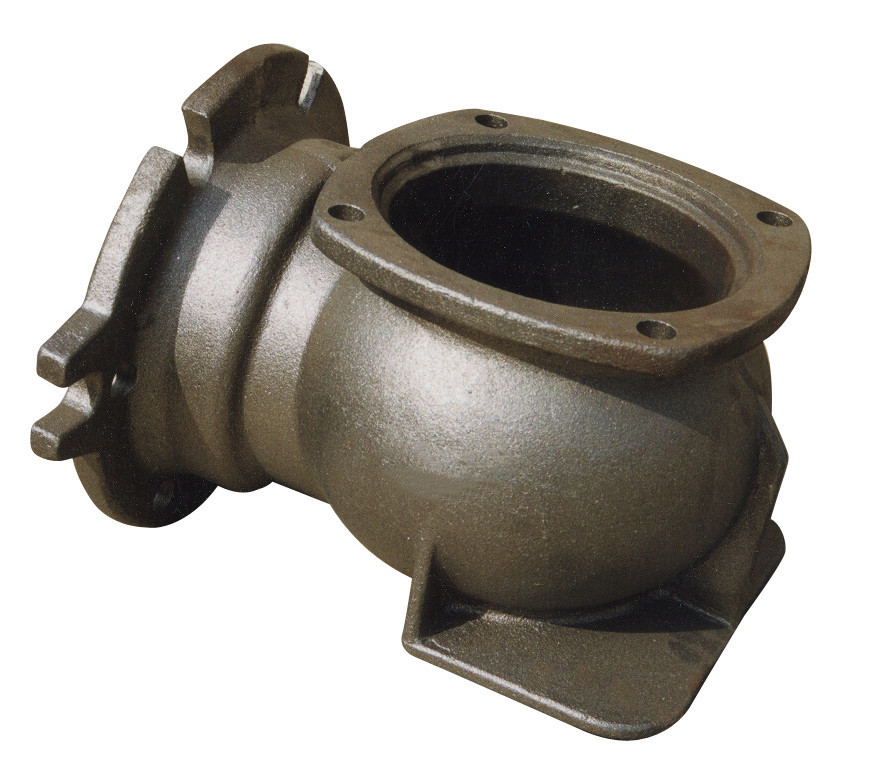
Cast iron can be divided into: 1. Gray cast iron. High carbon content, carbon mainly exists in the form of flake graphite, the fracture is gray, referred to as gray iron; low melting point, small shrinkage during solidification, compressive strength and hardness close to carbon steel, good shock absorption; used to manufacture machine tool beds, cylinders, boxes and other structural parts. 2. White cast iron. Low carbon and silicon content, carbon mainly exists in the form of cementite, the fracture is silvery white; large shrinkage during solidification, easy to produce shrinkage cavities and cracks; high hardness, large brittleness, can not withstand impact loads; it can be used as a blank for malleable cast iron to manufacture wear-resistant parts. 3. Malleable cast iron. Obtained from cast iron after annealing treatment, graphite is distributed in clusters, referred to as nodular cast iron. Its structure and properties are uniform, wear-resistant, and has good plasticity and toughness; used to manufacture parts with complex shapes and large dynamic loads. 4. Ductile iron. The molten iron of gray cast iron is spheroidized, and the precipitated graphite is spherical, referred to as ductile iron. Compared with ordinary gray cast iron, it has higher strength, better toughness and plasticity; used to manufacture internal combustion engines, auto parts and agricultural tools, etc. 5. Ductile iron. The molten iron of gray cast iron is vermicular, and the precipitated graphite is vermicular. The mechanical properties are similar to ductile iron, and the casting performance is between gray cast iron and ductile iron, used to manufacture auto parts. 6. Alloy cast iron. Ordinary cast iron is obtained by adding appropriate alloy elements. The alloy elements change the matrix structure of the cast iron, making it have corresponding heat resistance, wear resistance, corrosion resistance, low temperature resistance or non-magnetic properties, and is used to manufacture parts for mining, chemical machinery and instruments, meters, etc.
There are three types of cast steel: cast carbon steel, cast low-alloy steel, and cast special steel: 1. Cast carbon steel. Cast steel with carbon as the main alloying element and a small amount of other elements. Carbon content less than 0.2% is cast low carbon steel, carbon content 0.2% ~ 0.5% is cast medium carbon steel, carbon content greater than 0.5% is cast high carbon steel. As the carbon content increases, the strength and hardness of cast carbon steel increase. Cast carbon steel has high strength, plasticity and toughness, and low cost. It is used for parts that bear heavy loads in heavy machinery manufacturing, such as rolling mill frames, hydraulic press bases, etc. It is used for parts that bear strong stress and impact in railway vehicle manufacturing, such as bolsters, side frames, wheels, couplers, etc. 2. Cast low-alloy steel. Cast steel containing alloying elements such as manganese, chromium and copper. The total element content of the alloy is generally less than 5%, has greater impact toughness, and can obtain better mechanical properties through heat treatment. Compared with carbon steel, cast low-alloy steel has better service performance, can reduce the quality of parts, and extend the service life. 3. Cast special steel. There are many varieties of alloy cast steel refined to meet special needs, usually containing one or more high content of alloying elements to obtain certain special properties.
Although both cast iron and cast steel are iron-carbon alloys, due to the different percentage content of chemical elements such as carbon, silicon, manganese, phosphorus, and sulfur, they have different metallographic structures after crystallization, showing many differences in mechanical properties and process properties.
Cast iron
Previous Page
Previous Page


Shandong Gongchen Machinery Technology Co., Ltd.
Contact QQ: 258506508
Mobile Number:15621618888
Phone:0536-7691368 7691229
Fax: 0536-7691229
Contact Email:guisongzhng8@gmail.com
Website:www.shandonggongchen.com Gongchen.China Valve Castings.China
Address: Mucun Town, Fangzi District, Weifang City, Shandong Province
Public Account