
News Center
24
2021
-
03
Casting: Composition and introduction of ductile iron
Shandong Gongchen
Castings: Ductile iron is a high-strength cast iron material developed in the 1950s, with comprehensive properties close to those of steel. It is precisely because of its excellent properties that it has been successfully used to cast some parts with complex stress and high requirements for strength, toughness, and wear resistance.
Castings: Ductile iron Is a high-strength cast iron material developed in the 1950s, its comprehensive performance is close to steel, and it is based on its excellent performance that it has been successfully used to cast some parts with complex stress, high strength, toughness, and wear resistance requirements. Ductile iron has rapidly developed into a widely used cast iron material second only to gray cast iron. The so-called "iron instead of steel" mainly refers to ductile iron.
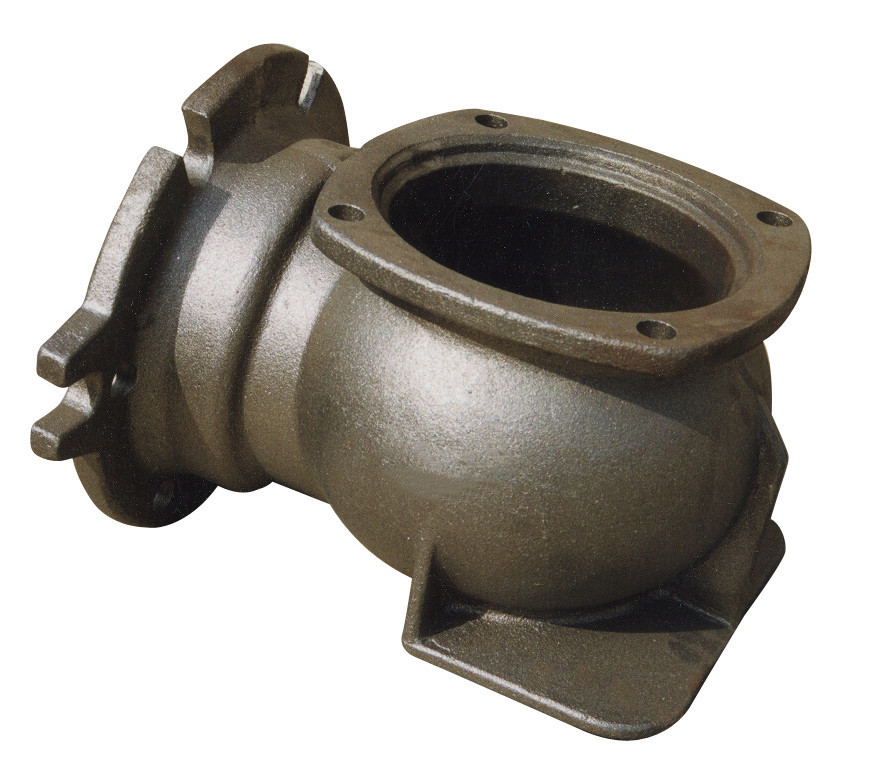
Castings Composition
Cast iron is an iron-carbon alloy with a carbon content greater than 2.11%. It is obtained by high-temperature melting and casting of industrial pig iron, scrap steel and other steel and alloy materials. In addition to Fe, it also contains carbon in other cast irons that precipitates in the form of graphite. Cast iron in which the precipitated graphite is in the form of flakes is called gray cast iron or gray iron, cast iron in which the precipitated graphite is in the form of vermicular is called vermicular cast iron, cast iron in which the precipitated graphite is in the form of clusters is called malleable cast iron or code iron, and cast iron in which the precipitated graphite is in the form of spheres is called ductile iron. The chemical composition of ductile iron, in addition to iron, is usually: carbon content 3.0~4.0%, silicon content 1.8~3.2%, total manganese, phosphorus, and sulfur content not exceeding 3.0%, and appropriate amounts of rare earth, magnesium and other spheroidizing elements.
Casting Precautions
(1) Strictly require chemical composition, the carbon and silicon content required for the original molten iron is higher than that of gray cast iron, and reduce the content of manganese, phosphorus, and sulfur in ductile iron.
(2) The furnace temperature of molten iron is higher than that of gray cast iron to compensate for the loss of molten iron temperature during spheroidization and inoculation treatment.
(3) Perform spheroidization treatment, that is, add spheroidizing agent to the molten iron.
(4) Add inoculant for inoculation treatment.
(5) Ductile iron has poor fluidity and large shrinkage, so it requires higher pouring temperature and larger pouring system size. It is reasonable to apply risers and chills, and adopt the principle of sequential solidification.
(6) Perform heat treatment
① Annealing. Obtain a ferrite matrix, improve plasticity and toughness, eliminate stress, and improve cutting performance.
② Normalizing. Obtain a pearlite matrix to improve strength and wear resistance.
③ Quenching and tempering. Obtain a tempered sorbite matrix structure and good comprehensive mechanical properties, such as spindles, crankshafts, connecting rods, etc.
④ Isothermal quenching. Make parts with complex shapes and high comprehensive performance requirements obtain a lower bainite matrix structure, as well as high strength, high hardness, high toughness and other comprehensive mechanical properties, and avoid cracking during heat treatment, such as spindles, crankshafts, gears, etc.
Casting, Compacted Graphite Iron, Foundry


Shandong Gongchen Machinery Technology Co., Ltd.
Contact QQ: 258506508
Mobile Number:15621618888
Phone:0536-7691368 7691229
Fax: 0536-7691229
Contact Email:guisongzhng8@gmail.com
Website:www.shandonggongchen.com Gongchen.China Valve Castings.China
Address: Mucun Town, Fangzi District, Weifang City, Shandong Province
Public Account